

The Rituals of Pushkar


We arrived in Pushkar on a Monday at noon. We came from Jaipur, one of the largest cities in the state of Rajashtan (northern India), so the choice of a village seemed as a good idea to us, with the possibility of lower the intensity, walk and rest; but clearly not what would be about to happen.
We stopped at a hotel on the outskirts of town, and I called ‘’outskirts’’ to everything eight blocks away from downtown.
If you are traveling in India you should know that the pictures published by the accommodations have nothing to do with the reality of the place. To make sure where you are going it is always good to read the comments about the place and thus it also becomes stronger and more fundamental the confidence in the traveling community.
But going back to the story… we were hungry so, after leaving our stuff at the hotel, we started walking. The road led to passages that led directly to the bazaar, one of the largest in the state of Rajasthan. Walking through its streets you can find hundreds of colorful shops, cows, dogs, motorcycles (that honk too loud to pass; even when there are no people interrupting the passage), many more tourists than we saw the rest of the trip and a lot of people from the local village.
Through the way of the Pushkar bazaar alleys are opened for all sides. Some end up in steep stairs, or snail style, that go up to temples, restaurants and Hostels; but the most beautiful are those that take you to the lake.
And here the essence of Pushkar: THE LAKE.
According to the holy story of Hinduism, thousands of years ago, Brahma (the creator god) threw a Lotus Flower on the ground and that from it the waters flourished. Today, the lake is considered sacred and Pushkar is the only place in India where a temple was built to honor Brahma.
We decided to go down to the lake through one of the alleys and found people from the village bathing in its waters and speakers coming from the temples projecting their prayers on loudspeaker. Actually, they make a cloud of impending sound, but they are part of the landscape. That was our first encounter with the lake. We looked at the landscape for a while and decided to go back to the central street to eat.
We entered a restaurant and ordered ''Momos'', typical food of the Tibet area. Living almost 5 months ago in India, you learn to distinguish between ‘’safe places of food’’ and those that involve a little bit more of ‘’prayer so that everything is well’’; well, this was one of the second kind.
We ate very tasty, today I can say it was safe food, and when we finished, we started to hear some drums coming from the central street of the bazaar. We went out to see what was happening and found a procession of the people of the village.
Hundreds of men and women were walking down central street. The men played drums and the women, colorful as always, danced to the rhythm of the music. As soon as they saw us standing there looking at them, they grabbed our hands and invited us to dance. Believe me, it was one of those sensations when you’re in the sea and you see the wave coming: either you get on or you get hit.
We danced with them over 10 blocks aprox.
What happened next was one of those magical and strange sensations at the same time. We danced being part of the ceremony without knowing what it was about, but with a strange sense of belonging. The women included us in their rounds and we imitated their footsteps while they were passing us into the hands of one and other women. The men would come, smile at us and give us the sound of their drums so that we would listen to them closely and dance to their rhythm.
Without realizing it, as I danced, tears began to fall from my eyes; there was a very special energy circling in the air. I copied women’s footsteps and cried. But I let tears fall, and I wished that women would understand that was because of happiness. I understood that I had this feeling, the thrill of being part of something bigger. It thrills me to be part of women’s rounds in any corner of the world, it thrills me to feel so welcome in a new culture. I’m excited to understand that no matter what part of the world we’re from, or what we believe in, there’s always a way to share.
What was happening in the village was the religious celebration for the completion of the reading of a sacred book of Hinduism and the anticipation of the celebration for the full moon and eclipse, which were to be the next night.
When we finished dancing, we sat down on the river. An Indian man of about 60 years of age came to talk to us. He told us that he was actually from Chennai, but that he had decided to take some sabbaths in Pushkar because of the stress his work in the city had generated. He now served drinking water to the local people and slept near the lake, on the stairs. He explained that if we wanted to walk on the lake, we had to do it clockwise because that way we could intentionally give blessings to our lives and drive away our karma.
Of course we did it that way…
We did it the next morning, as hundreds of women came to town to celebrate the full moon. The women arrived in trucks, those commonly used to transport cattle, but this time full of women dressed in very colorful sarees.
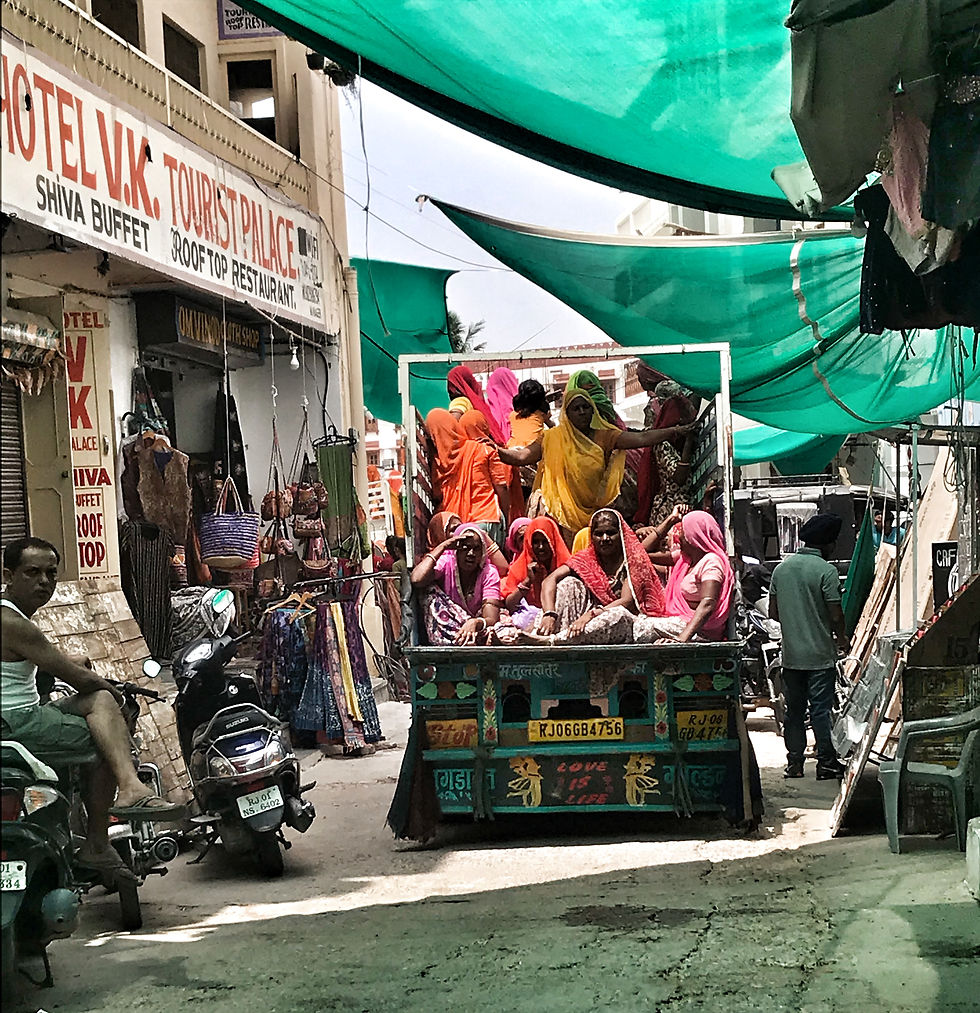
We walk along the lake in the direction of the clock needles, passing through the middle of the rounds of women gathered for prayer. The lake was so populated that at times we had nowhere to put our feet to walk. The ritual of prayer was repeated in every corner. In the middle of the round always the same structure built with sahumerium, flowers, fire, a coconut and something similar to corn. Some women prayed alone and others guided by a man dressed in white and wearing an orange turban on his head. A spiritual guide of Hinduism. Some women were in rounds and others already immersed in the sacred waters. Some women dived with the saree and others undressed on the shores of the lake.
We finished the turn, we sat in a stairway away from the crowd and we breathed in silence. We needed not to talk. I really don’t remember the last time I witnessed a ritual with such intensity. We were exhausted and grateful at the same time.
In the photo, the morning after the ritual, with the lake considerably empty compared to the morning before, a woman of Pushkar feeds the doves. I, sitting on the stairs that go down to the lake, drink mate and contemplate the landscape.

Comentarios